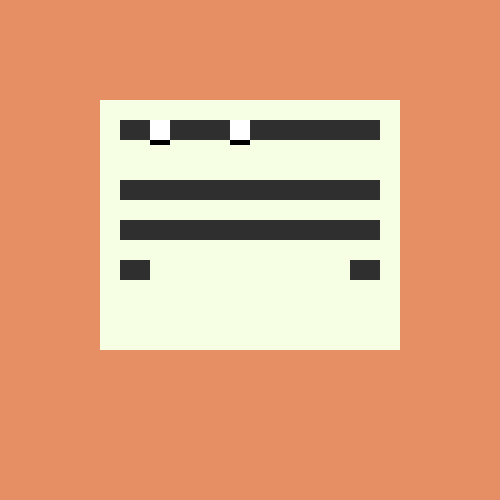
// Data Flow Diagram for News Blogging Theme
// A beautiful illustration of data flowing seamlessly between components
// Let's start by drawing the frontend component
ctx.fillStyle = "#FFC107"; // Bright yellow for a vibrant frontend
ctx.fillRect(100, 50, 100, 100); // A nice rectangular shape for our frontend
// Now, let's move on to the backend component
ctx.fillStyle = "#3F51B5"; // A deep blue for a powerful backend
ctx.fillRect(300, 50, 100, 100); // Another rectangular shape for our backend
// Time to add the database component
ctx.fillStyle = "#4CAF50"; // A refreshing green for a reliable database
ctx.fillRect(200, 200, 100, 100); // Yet another rectangular shape for our database
// Let's not forget about the external services and APIs
ctx.strokeStyle = "#E91E63"; // A vibrant pink for external services
ctx.lineWidth = 5; // A thick line to represent data flow
// Drawing the line from frontend to backend
ctx.beginPath();
ctx.moveTo(200, 150); // Starting point at the center of frontend
ctx.lineTo(300, 150); // End point at the center of backend
ctx.stroke();
// Drawing the line from backend to database
ctx.beginPath();
ctx.moveTo(350, 100); // Starting point at the right side of backend
ctx.lineTo(250, 200); // End point at the left side of database
ctx.stroke();
// Drawing the line from backend to external services
ctx.beginPath();
ctx.moveTo(250, 100); // Starting point at the left side of backend
ctx.lineTo(150, 150); // End point at the center of external services
ctx.stroke();
// Drawing the line from external services to frontend
ctx.beginPath();
ctx.moveTo(150, 200); // Starting point at the center of external services
ctx.lineTo(100, 150); // End point at the left side of frontend
ctx.stroke();
// Voila! Our beautiful data flow diagram is complete
// Now, let's sit back and relax as data flows smoothly between components
// "Data flowing like a gentle river, connecting components with a graceful quiver!"
These are recent AI images made by the community! These may use any AI model including DALL-E 3, Flux, Stable Diffusion, GPT-4, o1, and more and may be anything from simple animated SVGs to PNGs.
DrawGPT is a an AI art generator that uses GPT-4, o1, o3, DALL-E 3, Gemini 2.0, Imagegen 3.0, Flux, Stable Diffusion, and Custom GPTs, ChatGPT, and other large language models to generate new images from text prompts.
This does not require access to premium AI model subscriptions, it is able to be used by anyone with an internet connection and tokens. This allows everyone to get access to the very best AI art generation technology.
Artificial intelligence may create strange or unusual images. It is being used to generated images for advertising, entertainment, gaming, marketing, and fun right now!
Because Draw GPT has access to do many models we assume the model providers have followed best practices when attributing or utilizing data and images in the training data.
Yes! You can use the images for commercial purposes! And so can Draw GPT.
DrawGPT can draw anything you can think of and more! Just type your text prompt in to the textbox exactly like ChatGPT and see what the AI gives you! Seriously, you can get GPT to draw just about anything for you that you can type in the box.
DrawGPT creates images in PNG, SVG, and Javascript format for download and use. This is different than other AI art projects that only create images in PNG format; being able to get a scene graph via Javascript draw commands is a unique feature of this project and getting any AI art in SVG vector format is unique to DrawGPT.
Many people use this to generate quick art for simple projects, video game assets, new business logos, and more. It is also used to generate images for advertising, entertainment, gaming, marketing, creating art for ads and blog posts with AI and fun.
Want to learn more about DrawGPT, the types of possible image renders, and how to use DrawGPT in your next project as a developer?
Check out our AI image generation API!
DrawGPT is runs on an AI that has never actually "seen" an image as embodied AI in its life!
This method of drawing images using raw code is not a great way to draw complex images with lots of structure. It may be able to make photograph quality artwork and professional illustrations with AI but it can fail when using certain types of typography.
Yes and no. Same same but different.
ChatGPT runs on the same model that this project uses, so this is like using ChatGPT to generate images, but it is a different instance of the model. This means that the AI is not precisly the same but it is the same quality AI, image generation AI, large language model, and overall AI art that ChatGPT is using and that Chat GPT can draw.
What is the difference? ChatGPT is specifically wired up to be conversational and track a conversation thread across multiple user prompts. Images in ChatGPT using DALL-E 3 are not saved to the Intenet and made available publicly.
In comparison DrawGPT does not remember things from prompt to prompt, each image is a unique image that does not reference any of the images or prompts previously supplied.
You can do what you want it's your party.
We humbly ask that you backlink to DrawGPT if you do use our images in any promotion or commercial ways, but it is not required.
At the moment all images & Javascript code generated by this tool under the CC0 License with outrageous added term that the license can be revoked or retroactively changed at any time without warning for any image.
Yes! You can use the images for commercial purposes! And so can DrawGPT.
Images & prompts may be made made public.
Depending on the situation the prompts themselves are stored internally for research purposes.
Employees at OpenAI and DrawGPT have access to any prompts you submit.
DO NOT SUBMIT PERSONAL INFORMATION.